
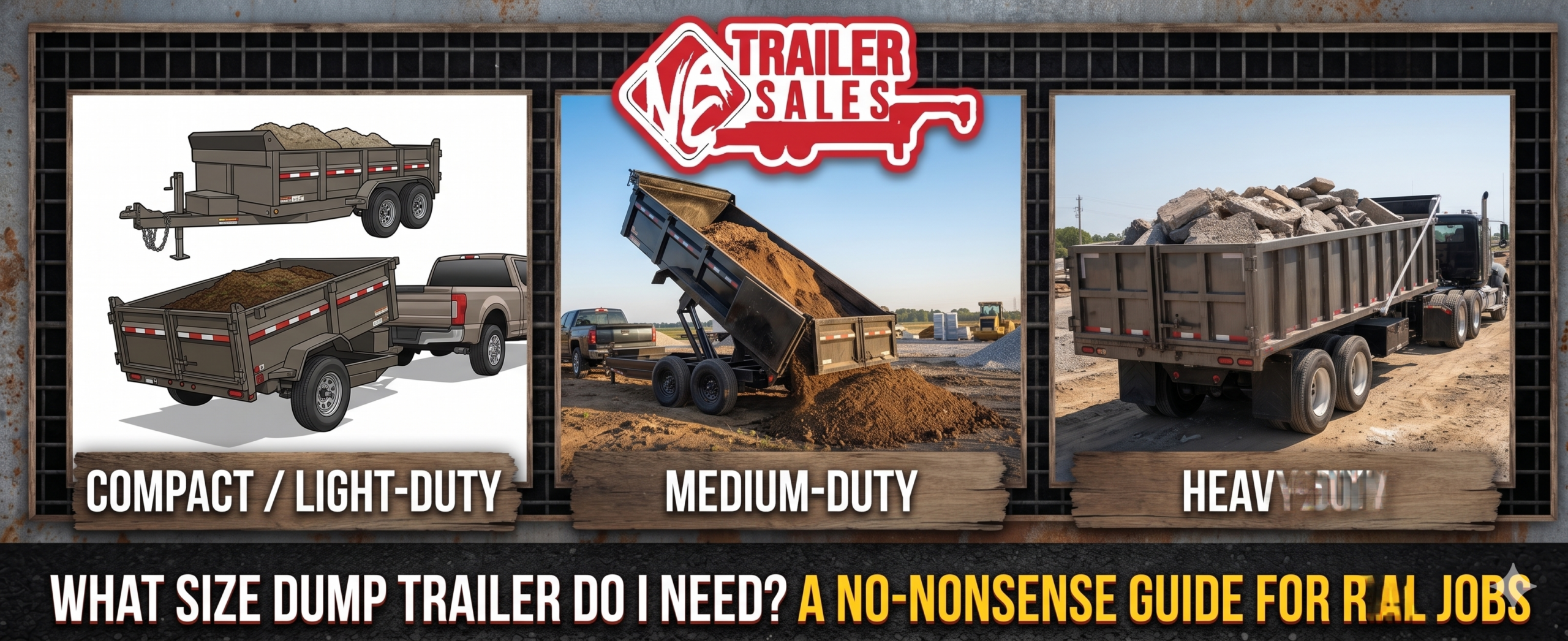
This is the question we field more than any other at the lot: "What size dump trailer should I buy?" And honestly, the answer almost always comes down to two things — what you're hauling and what your truck can actually pull. Everything else is noise.
There isn't one right answer. There are several right answers depending on your job. So here's how we walk through it with customers who roll up to the lot in North Augusta, and how you can figure it out yourself before you spend a dime.
Dump Trailer Capacity by Size
Struck capacity — that’s loaded level with the sidewall, not heaped up.
| Trailer size | 18″ sides | 24″ sides | 36″ sides | 48″ sides |
|---|---|---|---|---|
| 5x10 | 2.8 cu yd | 3.7 cu yd | 5.6 cu yd | 7.4 cu yd |
| 6x12 | 4.0 cu yd | 5.3 cu yd | 8.0 cu yd | 10.7 cu yd |
| 7x12 | 4.7 cu yd | 6.2 cu yd | 9.3 cu yd | 12.4 cu yd |
| 7x14 | 5.4 cu yd | 7.3 cu yd | 10.9 cu yd | 14.5 cu yd |
| 7x16 | 6.2 cu yd | 8.3 cu yd | 12.4 cu yd | 16.6 cu yd |
Find your sidewall height first. The footprint tells you less than the sides do — the same 7x14 can leave the factory with 18-inch sides or 48-inch ones, and that is the difference between 5 yards and 14. Every unit’s spec sheet lists it, and on a trailer you already own you can measure it in about ten seconds. Working with a size that isn’t on the chart? Multiply length × width × sidewall height in feet, then divide by 27.
Then check the weight, because that is usually what stops you first. A 7x14 on a 14K frame leaves around 9,600 lbs once the trailer’s own weight comes off the top, and wet topsoil runs about 2,400 lbs a yard — so you’re full near 4 yards whatever the sides are. Tall sides only earn their keep on light material like mulch, at roughly 600 lbs a yard, where you run out of box long before you run out of axle.
Quick Cheat Sheet
6x10 / 6x12 (10K GVWR) — Weekend warriors, homeowner cleanup, light landscaping.
7x12 / 7x14 (14K GVWR) — The sweet spot. Most landscapers and small contractors live here.
7x16 (14K GVWR) — Same capacity, more deck. Better for bulky/light loads like mulch.
7x16 (21K+ GVWR) or gooseneck — Real construction work. You need a 3/4-ton or one-ton to pull it loaded.
Step 1: What Are You Hauling?
Forget brand and color for a minute. Think about the heaviest, most common thing you'll dump in the bed. The math gets clearer fast once you do.
Dirt and wet soil are heavy — roughly 2,000–2,500 lbs per cubic yard wet. A 7x14 dump trailer with 2-foot sides holds about 7 cubic yards struck level. Do the math: that's 14,000–17,500 lbs of wet dirt, which already exceeds a 14K trailer's GVWR. In practice you only fill it 60–70% full when hauling wet soil.
Gravel and stone are similar — around 2,800 lbs per cubic yard. A 7x12 with 2-foot sides handles about 4 yards comfortably without going over weight.
Mulch and wood chips are light — 400–800 lbs per cubic yard. With mulch you'll cube out (run out of volume) long before you weight out. This is when a longer 7x16 with taller sides pays off — more cubic feet for the same trailer weight.
Demo debris, scrap, asphalt are dense but variable. Roofing tear-off averages around 1,500 lbs per pickup-bed load. Concrete chunks are heavy — limit yourself to half a yard at a time in a smaller trailer.
Step 2: What Can Your Truck Actually Pull?
This is where buyers get themselves in trouble. The trailer's GVWR isn't the same as your truck's tow rating, and the loaded trailer weight is what matters — not the empty trailer weight on the spec sheet.
Rough guidelines:
- Half-ton (F-150, 1500, Tundra): Comfortable up to a 10K loaded trailer. Stretching to 12K with the right tow package. A loaded 14K is borderline-to-illegal depending on your truck's specific tow rating.
- 3/4-ton (F-250, 2500, HD): Handles 14K all day. Can pull a 16K bumper-pull or step up to a smaller gooseneck.
- One-ton (F-350, 3500, HD): 21K bumper-pull or gooseneck territory. This is the truck for serious construction work.
If you don't know your truck's tow rating off the top of your head, check the door-jamb sticker or the owner's manual. The number on the dealer brochure ad is usually the maximum rating for the most-equipped version of your truck — yours may be lower.
Payload is usually the number that runs out first, and it’s the one almost nobody checks before they buy. We broke it down properly in payload vs. towing capacity — worth ten minutes before you commit to a size.
Step 3: How Often, How Far?
A weekend property owner who hauls mulch twice a year doesn't need the same trailer as a landscaping crew that's dumping six loads a day. Frequency drives spec.
Occasional use (under 20 loads a year): A 6x12 10K dump is plenty. Light enough to pull with most half-tons, small enough to back into tight driveways, cheap enough to make sense as a side purchase.
Regular use (a couple loads a week): This is where the 7x14 14K shines. Enough capacity that you're not making three trips for one job, light enough that it's not eating your fuel economy on every empty return.
Daily/commercial use: Go bigger and heavier than you think. A 7x16 14K or a gooseneck saves you trips, and the per-load cost on a busier trailer drops every year you own it.
The Three Sizes We Sell Most
Out of all the dump trailers that move through our lot, three sizes account for maybe 80% of what we deliver around the CSRA. Here's the honest read on each:
Compact: 6x12 10K Dump Trailer
The 6x12 10K — The cheapest way into a real dump trailer — call it a bit over half what a well-optioned 7x16 runs. Current pricing is on every listing. Pulls easy behind any half-ton with a brake controller. At 18-inch sides that’s about 4 yards struck, nearer 3 of anything wet. Taller sides change that a lot — the height is on every listing. This is the homeowner / hobby-farm / part-time-side-gig trailer. Don't go loading a skid steer's worth of dirt in it. For a pickup bed at a time, it's just right.
Mid-Size: 7x14 14K Dump Trailer
The 7x14 14K — Reckon on roughly half again the price of the 6x12, with options swinging it more than anything else. The trailer most of our landscape and contractor customers end up buying. Capacity depends entirely on the sides — roughly 5 yards at 18 inches, 7 at 24, 11 at 36. Either way you’re weight-limited near 4 yards on anything wet, handles real loads of gravel without straining, and a 3/4-ton truck pulls it loaded without breaking a sweat.
Heavy-Duty: 7x16 14K (or 21K Gooseneck)
The 7x16 14K (or 21K gooseneck) — The top of the range, and a wide one — gooseneck and hoist choices move it hard. For when you're moving real volume and want fewer trips. The gooseneck version is the upgrade that pays for itself if you're hauling daily — it tows smoother, backs easier, and the 21K capacity means you can actually fill it with heavy stuff.
You can browse our current dump trailer inventory here — most of what we stock is Load Trail because the frames hold up to actual contractor abuse, not just brochure photos.
A Few Things People Don't Think About
Side height matters as much as length. A 24-inch side holds twice the volume of a 12-inch side on the same trailer — double, not a little more. If you're hauling light material (mulch, brush, leaves), taller sides are worth more than more length.
Where you're dumping changes everything. If you regularly back into low-clearance areas — under tree limbs, into a job site with a fence — a scissor-lift dump bed clears those obstacles. A telescopic or hydraulic-cylinder dump might not.
Tongue weight on a loaded dump is serious. A loaded 14K bumper-pull puts 1,400+ lbs on your hitch. Your truck's hitch rating and rear suspension need to be ready for that. A weight-distributing hitch isn't always enough.
Resale matters if you're upgrading later. 7x14 14K dumps hold value better than the small ones or the niche big ones because they're what most buyers want. Buy the in-demand size and you'll lose less when you trade up.
Still Not Sure What Size?
Tell us what you're hauling, what you're towing it with, and how often you'll use it. We'll point you to the right size — and tell you if a smaller (or bigger) one would actually fit your job better.
No upsell. No pressure. We'd rather get you in the right trailer the first time than sell you a bigger one twice.
We deliver dump trailers across Georgia and South Carolina from our lot at 5950 Jefferson Davis Highway in North Augusta — including Augusta, Aiken, Hephzibah, and the rest of the CSRA.