
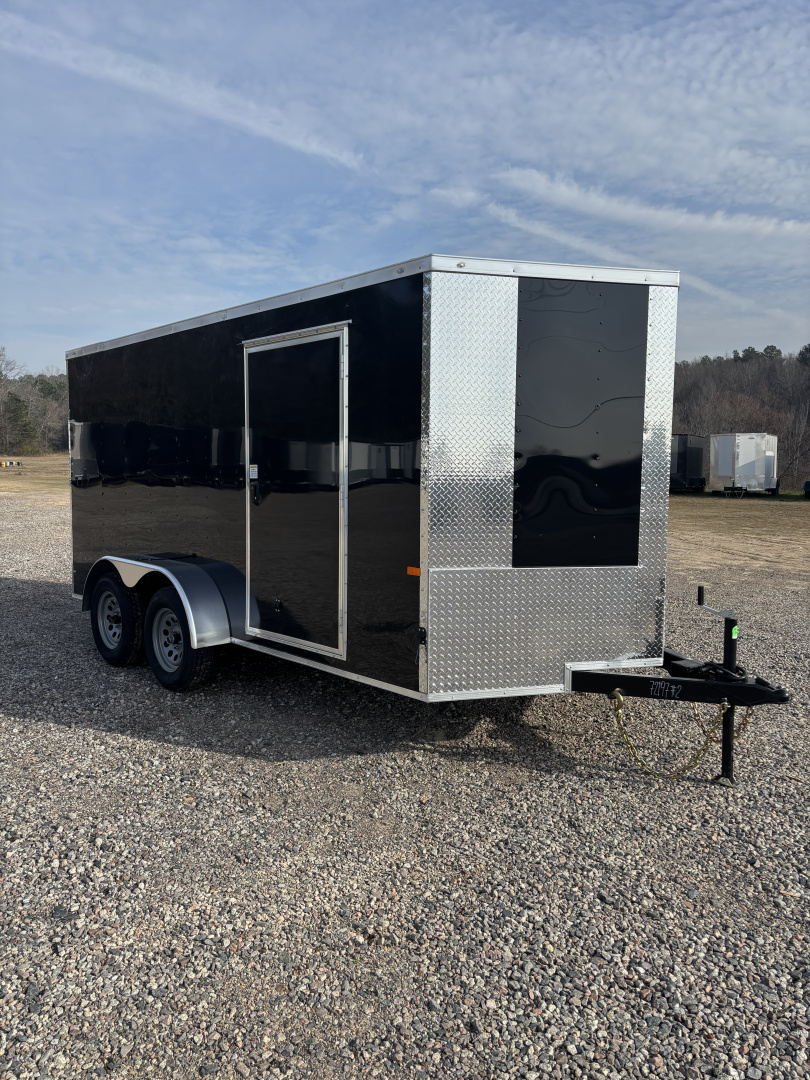
Somebody stands in front of the two rows at the lot and asks the same thing every week: do I want the open one or the closed one? Sounds like a matter of taste. It really isn’t — it comes down to what you haul, where you park, and how much of your truck’s payload you’re willing to give up before you’ve loaded anything.
Here’s how we actually talk it through.
The trade-off in one sentence
A utility trailer is lighter, cheaper and easier to load. An enclosed trailer keeps your things dry and locked. Nearly everything else follows from that.
Where the open trailer wins
They win on the practical stuff more often than people expect.
- Loading from any side. A mower, a pallet, an awkward length of pipe — you’re not threading it through a door. If you load and unload a dozen times a day, this alone decides it.
- Weight. A single-axle 6x12 utility trailer runs somewhere around 1,000 to 1,400 lbs empty. The enclosed equivalent is closer to 1,600 to 2,000. That difference comes straight out of what you can carry.
- Tall and odd loads. No roof means no height limit. Brush, a bobcat with the cage up, furniture stacked higher than you’d admit to.
- Price. For the same footprint you’ll spend meaningfully less, and you can put the difference toward a bigger trailer or better axles.
- Wind. An open deck barely notices a crosswind. A tall enclosed box very much does.
Where the closed one earns its money
Enclosed trailers win on everything that happens when you walk away from the trailer.
- Security. Tools stay locked up overnight instead of coming into the garage every evening. For a lot of contractors this is the whole argument, and it ends the conversation.
- Weather. Drywall, upholstery, a motorcycle, anything that shouldn’t get rained on for three hours on I-20.
- It doubles as storage. Plenty of our customers use theirs as a rolling job box that happens to have wheels. You stop unloading at the end of every day.
- Your name on the side. A clean box is a billboard that parks itself in a customer’s driveway all day.
- Resale. Enclosed trailers tend to hold their money well, partly because the market for them is wider.
The weight difference matters more than the price difference
This is where the decision usually gets made, and it’s the part people skip.
An enclosed trailer’s extra structure is dead weight you carry on every trip, and a chunk of it lands on your hitch as tongue weight — which comes out of your truck’s payload before you load a single tool. We went through that math in detail in payload vs. towing capacity, and it’s worth reading before you decide, because the enclosed trailer that looks perfect on the lot is sometimes the one your half-ton can’t comfortably pull loaded.
So if your truck is already close to its limit, the open trailer buys you a few hundred pounds of usable capacity for free.
Three things people find out later
- Measure your gate and your garage. Enclosed trailers commonly run six to seven feet of interior height and taller than that overall. People discover their storage unit door or their own carport won’t take it after they’ve bought.
- Fuel economy is not a rounding error. Towing a tall box is noticeably thirstier than towing an open deck at highway speed. Over a year of daily use that adds up to real money.
- Ramp door or barn doors is a real decision. A ramp is essential if you’re rolling anything in. Barn doors are better if you’re loading by hand in tight spaces and want the doors out of the way.
How we’d steer you
Go utility if you’re a landscaper loading and unloading mowers all day, hauling brush or debris, moving pallets and materials, or you only need a trailer occasionally and want to spend less.
Go enclosed if you carry tools you don’t want stolen, haul anything that can’t get wet, want your business name on the road, or you’re moving a motorcycle, side-by-side or car.
Consider a dump trailer instead if what you’re actually hauling is dirt, gravel, mulch or demo debris — you don’t want to shovel any of that out of an open utility trailer twice a day. Our dump trailer sizing guide covers that side.
Come look at both
Ten minutes standing between the two rows settles this faster than any article. We stock utility trailers from Bear Track and enclosed trailers from Rock Solid Cargo, and we’ll tell you honestly if the one you’re drawn to is wrong for your truck.
We’re at 5950 Jefferson Davis Highway in North Augusta. Browse utility trailers or enclosed trailers online, call (803) 844-3242, or come by and put your hand on both. We also handle financing and have a service department for whichever one you drive home.